Industrial laundry is tough love.
Big drums. Hot water. Alkaline chemistry. Hard spin. Steam tunnels.
Pretty logos can fade, fuzz, or pop if we don’t plan right.
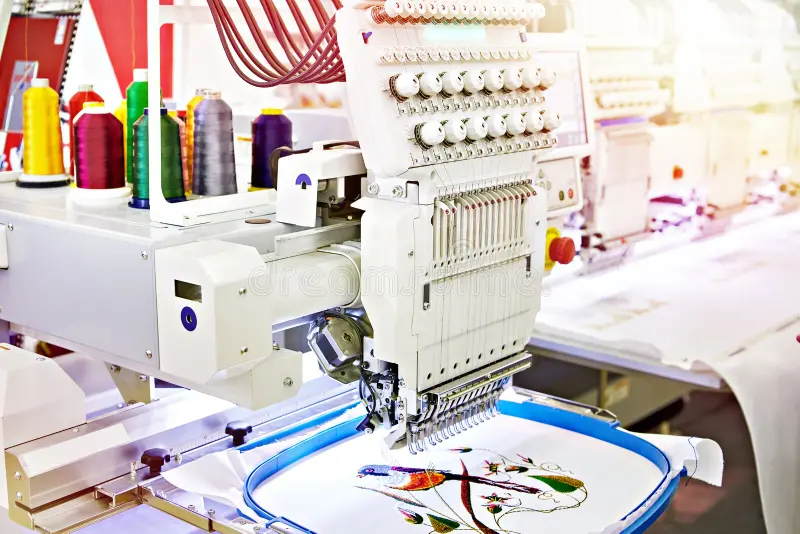
The fix is a recipe: the right thread, needle, backing, digitizing, and care. Do this well and your marks stay tidy after dozens of wash cycles.
Why uniforms lose their look
- Heat & high pH break weak dyes and soften cheap finishes.
- Mechanical action rubs stitches until filaments fray.
- Moisture + pressure flatten tall satin columns and show wear lines.
- Wrong backing lets fabric stretch, the design distorts, and edges open.
Good news: all of these are controllable.
Choose thread for the job (start here)
- Trilobal polyester (40 wt / ≈ Tex 27) for most hotel, hospital, and workwear logos. It keeps color in hot water, handles bleach better than rayon, and stays shiny.
- Solution-dyed core colors (black, navy, red, royal) where available: best fade hold.
- Meta-aramid embroidery thread only when the garment must be flame-resistant end-to-end (FR coveralls). Use sparingly; it is matte and stiffer.
- Spun polyester bobbin to match the top; pre-wounds reduce stops and keep tension stable.
Avoid: metallic threads for laundry-heavy garments—they scratch, dull, and shed in tunnels.
Needle & tension (small, steady, sharp)
- Knits: ball-point (SES) NM 75/11 for polos and tees.
- Wovens/twill: light sharp or micro-point NM 75/11–80/12.
- Heavy patches/caps: move to NM 80/12–90/14.
- Balance tension to show a tiny “bobbin dot” on the back—just visible. Too tight cuts, too loose loops.
Change needles early; a tired point chews thread and fabric, then the washer finishes the damage.
Backing & topping (the quiet heroes)
- Cut-away backing (80–120 gsm) on knits: it stays for life and stops distortion.
- Tear-away only on firm wovens that won’t stretch.
- No-show mesh for light tees where hand feel matters.
- Water-soluble topping on pile (fleece/terry) so stitches don’t sink; it rinses out in the first wash.
Trim backings to soft ovals—square corners curl in dryers.
Digitizing that fights the wash
Embroidery fails more from bad digitizing than bad thread. Use these guards:
- Underlay: edge-run to anchor + zigzag to lift columns.
- Density: start near 0.40–0.45 mm for satin columns. On heavy twill, open a bit; on stretch knits, keep supportive but not jammed.
- Pull compensation: 0.2 mm typical. It stops skinny outlines after the first hot wash.
- Satin vs. fill: use satin up to ~7 mm width. Wider? switch to fill to avoid cracking and snags.
- Minimum stitch length: ≥ 1.0–1.2 mm. Micro-stitches break in laundry.
- Tie-ins/offs: 3–4 small locks, tails trimmed clean.
- Travel smart: reduce trims; each trim is a weak point in harsh cycles.
Three sector “recipes”
Hotels (white linens, front-of-house polos)
- Thread: 40 wt trilobal polyester thread or textured thread; solution-dyed for black/navy.
- Needle: SES 75/11 on piqué knits.
- Backing: 90 gsm cut-away + water-soluble topping on piqué.
- Digitizing: density 0.42 mm, pull comp 0.2 mm, satin ≤ 6.5 mm.
- Notes: prefer tone-on-tone for a clean, upscale look that hides abrasion. If towels/robes: open density 5–10% and always use topping.
Hospitals (infection control, frequent bleach)
- Thread: bleach-tolerant polyester; avoid rayon and metallic.
- Needle: micro-point 80/12 for tight poplin; ball-point 75/11 for scrubs knit.
- Backing: cut-away (100–120 gsm) for scrub tops; tear-away for drapes where allowed.
- Digitizing: avoid micro details; go bolder shapes that survive disinfect cycles.
- Notes: if any antimicrobial claims, choose non-leaching, metal-free finishes and keep documentation.
Workwear (oil, heat, abrasion, FR options)
- Thread: bonded polyester embroidery for scuff zones; meta-aramid only when garment must be FR-compliant.
- Needle: 80/12–90/14; coated needles reduce heat glaze on heavy canvases.
- Backing: heavier cut-away; consider two layers under stress logos.
- Digitizing: split wide satins to fill; add corner radii; bar-tack style locks at strap roots.
- Notes: place logos away from edge binders and high-wear seams where grinders or harness points rub.
Testing that tells truth (before a big order)
- Industrial wash cycles: 5, 10, then 25 cycles at target temp/chemistry. Score color, fuzz, breaks, lift.
- Tunnel finisher heat: press/steam as in plant; watch for gloss or shrink wave. If gloss appears, reduce density or switch thread finish.
- Abrasion rub: 100–200 dry rubs on the logo. Fuzz = open density slightly or step needle up one size.
- Snag probe: drag a rounded hook across satin columns. Snag? split the satin or swap to fill.
- Bleach spot check (healthcare): diluted per facility; confirm no shade shift or halo.
Common problems & quick fixes
| Problem after laundry | Likely cause | Fast fix |
| Color fade | Rayon / poor wash-off | Switch to polyester; solution-dyed for core shades |
| Edge fray / outline shrink | No pull comp / thin underlay | Add 0.2 mm comp; edge-run + zigzag underlay |
| Column cracking | Satin too wide / too dense | Split to fill; open density 5–10% |
| Looping on top | Tension imbalance / missing topping | Rebalance; add water-soluble topping on pile |
| Puckering | Backing too weak / stitch jam | Heavier cut-away; reduce density; check tension |
Care label words that help
“Wash warm with like colors. No chlorine on brights. Do not iron directly on embroidery—use a cloth. Air or low heat. If snag happens, trim carefully; don’t pull.”
One-week pilot plan (simple & real)
- Pick one logo.
- Sew three variants: A) standard rayon (control), B) 40 wt polyester, C) polyester + refined underlay/density.
- Run 10 industrial cycles + tunnel finisher pass.
- Grade shine, color, fuzz, breaks, hand feel.
- Lock winner; save DST/EMB file, thread brand/lot, needle, backing in the tech pack.
Wrap
Embroidery can look fresh after heavy service—if you build it like a pro.
Choose polyester threads, support with the right backing, digitize with smart underlay, density, and pull comp, and test against the real wash line.
Hotels, hospitals, and workwear each need small tweaks, but the recipe stays the same: clean inputs, calm needles, honest tests.
Do that, and your logos stay proud from week one to wash twenty-five and beyond.